





Blogs
- What Currency Counting and Sorting Machines Actually Do
- How to Choose the Right Machine for Your Business
- Counterfeit Detection and UAE Central Bank Compliance
- Ready to Upgrade Your Cash Handling Setup?
- Manual Counting vs Automated Machines: What It Actually Costs You
- Handling Multiple GCC Currencies
- Key Features to Check Before You Buy
- Final Thoughts
- Talk to a Cash Handling Specialist
- Frequently Asked Questions
- Products by Category
If you have ever watched a cashier flick through a stack of Dirhams by hand while a queue forms behind them, you already understand the problem this article solves. Manual counting is slow, it tires people out, and tired people miscount. That is not an opinion, it is just how hands work after the tenth stack.
Currency counting and sorting machines fix this. But most buying guides online are really just product catalogues with a paragraph of filler on top. This one is different. It walks through how these machines work, how to pick the right one for your business type, what UAE regulators expect from you, and how the GCC’s multi-currency reality changes your shopping list.
What Currency Counting and Sorting Machines Actually Do
People use “counter” and “sorter” interchangeably, and honestly, the industry does not help. Here is the real difference.
A counter totals the notes you feed it. A sorter (also called a discriminator) physically separates notes into pockets by denomination, currency, or condition while it counts. Many modern machines now do both in a single pass, which is exactly why the terms blur together in everyday conversation.
If you want the deeper breakdown, including the seven distinct machine categories and where each one fits, Ostmena’s guide on types of currency counting machines covers it in more detail than we need here.
For counterfeit protection specifically, most business-grade machines combine UV, magnetic (MG), and infrared (IR) sensors to flag suspect notes before they ever reach your till. We break down exactly how that combination works in our UV, MG, and IR detection explainer.
How to Choose the Right Machine for Your Business
The “best” machine depends entirely on what your business does with cash all day. Here is how that plays out across the sectors we work with most.
Money Exchanges and Cash Offices
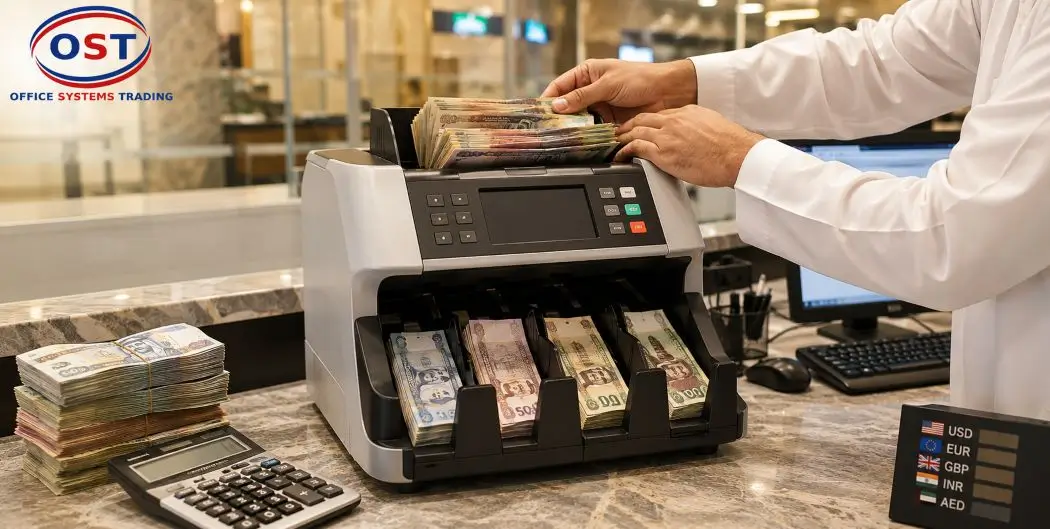
Exchange houses handle mixed denominations, multiple currencies, and a legal obligation to catch counterfeits. This calls for a multi-currency discriminator with strong UV/MG/IR coverage, not a basic single-currency counter. Volume here is constant, so durability matters as much as speed.
Retail, Supermarkets and Restaurants
A busy till sees a jumble of notes from many hands throughout the day. A mixed-denomination counter that totals everything automatically saves a manager from sorting cash by hand at closing time. Counterfeit detection still matters, since retail cashiers rarely have time to inspect every note closely.
Hotels and Hospitality
Front desks and F&B outlets tend to deal with tourists carrying foreign currency alongside AED. A multi-currency sorter, like the Hitachi ST-350N, handles that variety without forcing staff to switch machines or modes constantly.
Banks, CIT Companies and Cash Processing Centres
This tier needs heavy-duty, high-throughput equipment built to run for hours without a break. Speed, note-condition (fitness) sorting, and bank-grade counterfeit detection are non-negotiable, since these operations move far larger volumes than a retail counter ever will.
If you are still unsure which category fits, Ostmena’s Currency Counting & Sorting Machines range groups models by brand and function, which makes comparing options easier than scrolling a generic catalogue.
Counterfeit Detection and UAE Central Bank Compliance
This is the part most competing articles skip entirely, and it genuinely matters if you handle cash professionally in the UAE.
The Central Bank of the UAE regulates currency exchange activity directly, and its Exchange Business Regulation lists <cite index=”68-1″>Counterfeit Currency Reporting and AML/CFT Compliance as distinct, dedicated obligations for licensed exchange businesses</cite>. In plain terms, catching a fake note is not just good practice, it is a defined regulatory duty for licensed exchange houses.
The Central Bank Law backs this up at the legislative level too. Under Article 55(2), <cite index=”69-1″>no person may issue or circulate notes, coins, or bearer instruments that resemble legal tender in the UAE or elsewhere</cite>. Licensed financial institutions are expected to keep counterfeit notes out of circulation entirely, whether the notes come in through collection, transactions, or deposits.
What does this mean for your buying decision? If your business touches cash professionally, especially as an exchange house, a UV/MG/IR-equipped machine is not a luxury feature. It is the tool that keeps you on the right side of a documented regulatory requirement, and it is far cheaper than absorbing a fake note that a bank will never credit back to you.
Ready to Upgrade Your Cash Handling Setup?
If your current process still relies on manual counting or an outdated single-sensor machine, it is worth a five-minute conversation before your next busy season hits. Browse Ostmena’s Currency Counting & Sorting Machines and compare models by brand, speed, and detection technology in one place.
Contact Ostmena’s team →Manual Counting vs Automated Machines: What It Actually Costs You
Nobody publishes a universal ROI number for this, and honestly, anyone who does is guessing. But the logic holds up regardless of your specific numbers.
Every minute a staff member spends recounting a cash drawer is a minute they are not serving customers, restocking, or doing literally anything else you pay them for. Multiply that across every shift handover, every day, every till, and the hours add up fast.
Then there is the error side. A miscount during a shift handover creates a discrepancy that someone has to chase down later, usually by recounting everything from scratch. A machine does not get tired at hour seven of a shift. It counts the same way at 11 PM as it does at 9 AM.
Counterfeit losses compound this further. A fake note accepted at the register is gone the moment your bank identifies it, since banks do not reimburse counterfeit currency. One machine-caught fake note can offset a meaningful chunk of what the machine cost in the first place.
None of this requires exact figures to be convincing. It is basic arithmetic: fewer manual hours, fewer reconciliation errors, and fewer absorbed losses, applied consistently, day after day.
Handling Multiple GCC Currencies
Most currency counter content online treats AED as the only currency in the room. That is a strange gap, considering how much business genuinely crosses GCC borders.
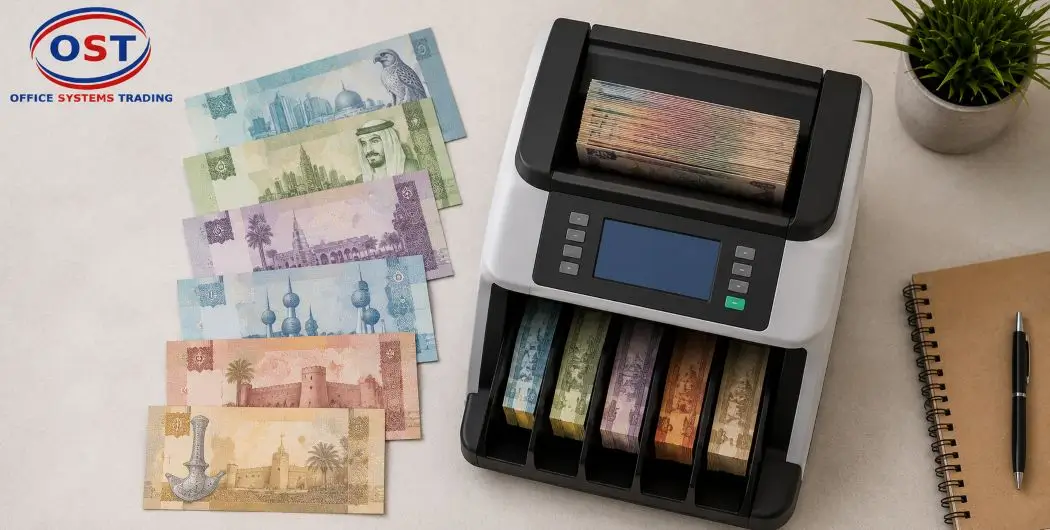
If your operations touch Saudi Arabia, Qatar, Kuwait, Bahrain, or Oman, in addition to the UAE, your machine needs to recognise SAR, QAR, KWD, BHD, and OMR alongside AED, not just count them as generic paper. Multi-currency sorters solve this by storing recognition profiles for each currency and automatically applying the right sorting and counterfeit-detection logic per note.
This matters most for money exchanges, logistics and CIT companies, and retail chains with a GCC-wide footprint. A single-currency counter forces staff to switch machines or run manual checks whenever a foreign GCC note shows up, which defeats the entire point of automating the process.
Key Features to Check Before You Buy
Before you commit to a model, run through this checklist:
- Counting speed (notes per minute) matched to your actual daily volume, not the highest number on the spec sheet
- Detection technology: UV, MG, and IR coverage at minimum, with image-based (CIS) sensors for higher-risk environments
- Currency support: confirm AED plus any other GCC or international currencies you regularly handle
- Sorting pockets: one for basic counting, two or more if you need to separate rejects, denominations, or currencies automatically
- Hopper and stacker capacity: higher capacity means fewer manual reloads during busy periods
- Maintenance support: check whether an annual maintenance contract is available locally, since cash-handling equipment sees daily wear
Final Thoughts
Picking a currency counting or sorting machine is not really about the flashiest spec sheet. It comes down to three questions: how much cash moves through your business, how many currencies you actually handle, and how exposed you are to counterfeit risk.
Get those three answers right, and the rest of the decision, counter versus sorter, single-currency versus multi-currency, tabletop versus heavy-duty, falls into place on its own. A UAE retail till and a GCC-wide exchange house are not shopping for the same machine, and they should not be reading the same generic checklist to choose one.
Compliance is not a side note either. For licensed exchange businesses, catching counterfeit currency is a defined regulatory duty, not an optional upgrade. Treating detection technology as core equipment, rather than an add-on, keeps your business both efficient and on the right side of UAE Central Bank requirements.
If you take one thing from this guide, let it be this: match the machine to your actual cash flow, not the other way around. Ostmena’s team can help you do exactly that.
Talk to a Cash Handling Specialist
Choosing between a counter, a sorter, and a full discriminator gets easier with the right guidance. Ostmena’s team works with banks, exchange houses, and retailers across the UAE and GCC daily, and can match a machine to your actual volume and currency mix rather than selling you the biggest box on the shelf. Get in touch with Ostmena for a recommendation built around your business.
Get in touch with Ostmena →Frequently Asked Questions
A counter totals the value or quantity of notes fed into it. A sorter, or discriminator, physically separates notes into different pockets by denomination, currency, or condition while counting, which a basic counter cannot do.
Most business-grade machines use UV, MG, and IR sensors together to flag suspect notes, including counterfeit AED. Coverage varies by model, so it is worth confirming which detection methods a specific machine supports before buying.
Yes, multi-currency sorters and counters are built for exactly this. They store recognition profiles for each supported currency, which lets a single machine handle AED alongside other GCC currencies without manual switching.
Yes. The UAE Central Bank’s Exchange Business Regulation lists counterfeit currency reporting as a distinct compliance obligation for licensed exchange businesses, separate from general anti-money laundering requirements.
It comes down to your cash volume, the number of currencies you handle, and whether you need sorting alongside counting. A small retail till usually needs a simple mixed-denomination counter, while an exchange house or bank branch typically needs a multi-currency discriminator with heavy-duty sorting.
Products by Category
-
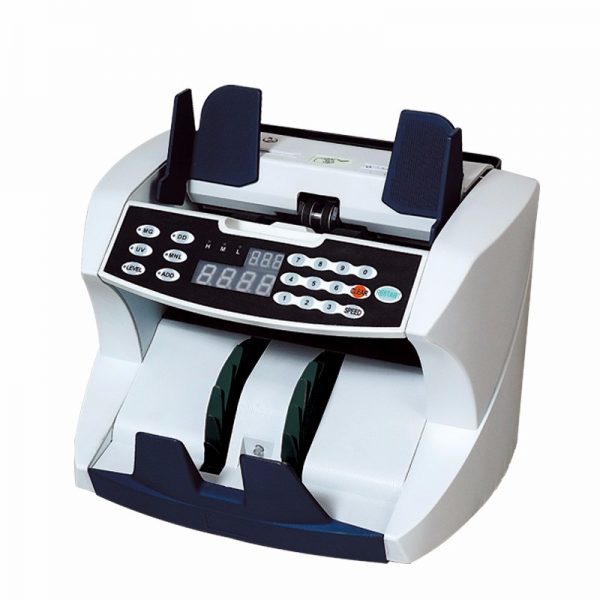
BAIJIA BJ-2100UV Currency Counting Machine
575.00 AED -
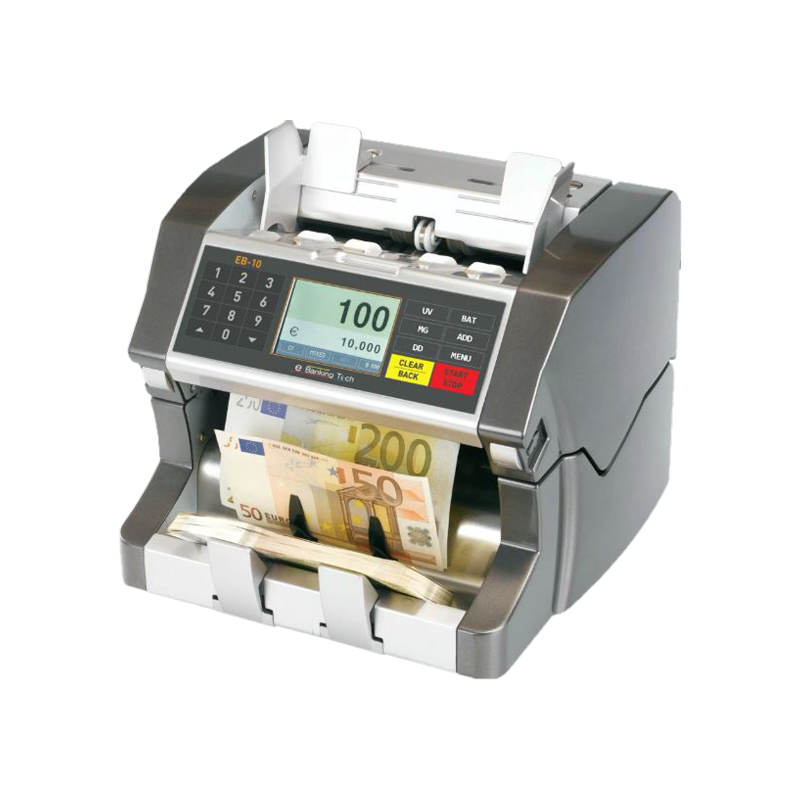
EBANKING EB-10 Heavy Duty Currency Counter
2,300.00 AED -
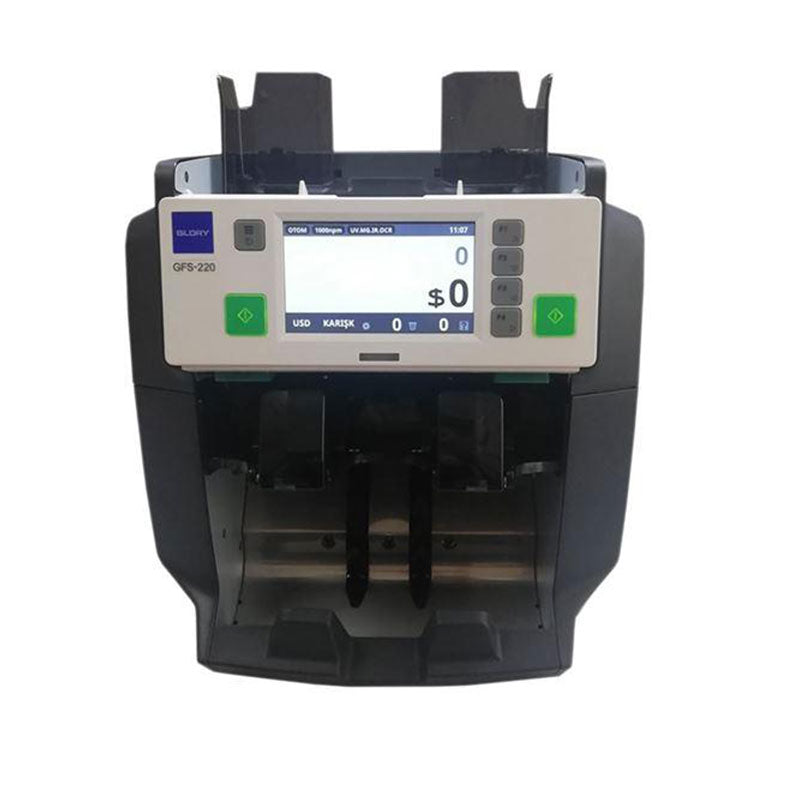
GLORY GFS220CS Banknote Counting Machine
9,200.00 AED
