





Blogs
- 1. How Many Currencies Do You Actually Handle?
- 2. Single Pocket, 2-Pocket, or Multi-Pocket Sorter?
- 3. What Counting Speed Does Your Volume Actually Need?
- 4. Which Counterfeit Detection Sensors Actually Matter?
- 5. Do You Need Fitness Sorting?
- See the Full Range Before You Decide
- Products by Category
- 6. What's the Real Price Range, and Why?
- 7. What Happens After You Buy?
- Quick Comparison: Entry-Level vs Mid-Range vs High-End
- Get Matched With the Right Machine, Not Just a Machine
- Frequently Asked Questions
Buying a currency counter sounds simple. You search online, you see a machine with a big “Multi Currency” sticker on the box, and you assume every model does roughly the same job. Then you get quotes ranging from a few hundred dirhams to well over fifty thousand, and suddenly it doesn’t feel simple at all.
The truth is that “multi-currency counting machine” covers everything from a basic desktop counter that recognizes two or three currencies to a bank-grade sorter processing thousands of notes an hour across 32 currencies. Buying the wrong one wastes money either way, whether you overspend on features you’ll never use or underspend and jam the machine every second day.
This guide walks through the seven questions worth answering before you buy, using real specs and pricing from the GCC market so you’re comparing facts, not marketing language.
1. How Many Currencies Do You Actually Handle?
Start here, because it changes everything downstream. If your business mostly deals in AED with the occasional USD note, you don’t need a machine that supports 32 currencies. You need reliable dual-currency detection and solid counterfeit checks.
If you run an exchange house or a hotel finance office handling notes from a dozen different countries, currency capacity becomes the whole ballgame. The Hitachi IH-210 supports up to 32 currencies, which covers nearly any combination a GCC business is likely to see in a normal week.
Be honest about your actual volume here, not your aspirational volume. Paying for 32-currency support you’ll use for three currencies is money you could have spent elsewhere.
2. Single Pocket, 2-Pocket, or Multi-Pocket Sorter?
This is about workflow, not just counting. A single-pocket machine counts and totals but dumps every note into one tray. Fine for a small till. Painful for anything busier.
A 2-pocket sorter, like the Plus P-30, separates rejected or mismatched notes from verified ones automatically. A 3-pocket model, like the Hitachi IH-210, goes further and splits notes by denomination or currency across multiple stackers.
If your staff currently spend time manually separating notes before or after counting, a multi-pocket sorter removes that step entirely. That’s usually where the real time savings live, more than the counting speed itself.
3. What Counting Speed Does Your Volume Actually Need?
Counting speed gets marketed heavily, but most businesses never touch a machine’s maximum speed during normal operation. Still, it’s worth matching roughly to your daily load.
The Hitachi IH-210 counts at 1,300 notes per minute. The Hitachi ST-350N runs value counting at 1,000 notes per minute and fitness sorting at 700 notes per minute. The Glory GFB-800 reaches roughly 1,800 notes per minute, among the faster options available.
A small retail counter rarely needs to touch 1,000 notes per minute. A remittance center processing hundreds of transactions during a busy afternoon absolutely benefits from it. Match the number to your queue length, not to the biggest figure on the spec sheet.
4. Which Counterfeit Detection Sensors Actually Matter?
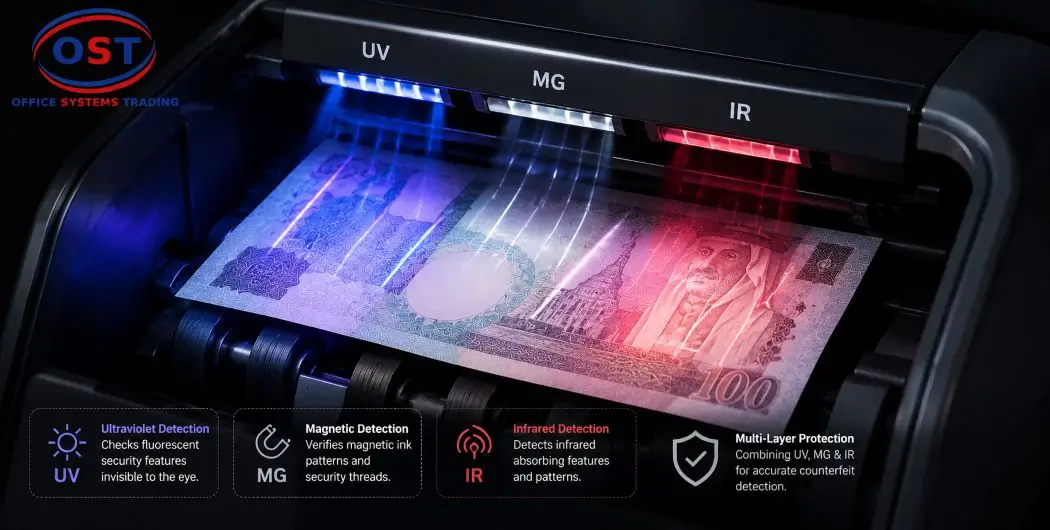
Every listing mentions UV, MG, and IR detection, and it’s easy to assume they’re all equal. They’re not quite, but the combination matters more than any single sensor.
UV (ultraviolet) checks for security features that glow under UV light. MG (magnetic) detects magnetic ink used in genuine notes. IR (infrared) studies how a note absorbs and reflects infrared light, since real notes create a specific pattern counterfeits usually fail to match. CIS (contact image sensors) capture a high-resolution image of the note for visual comparison.
Machines combining multiple methods catch more than any single-sensor device, since forgery techniques keep evolving and no single check catches everything alone. The IH-210 combines dual full-color CIS, full-line MG, IR, UV, and a tape detection sensor, which is a genuinely thorough combination for the price point.
5. Do You Need Fitness Sorting?
Fitness sorting is a feature most small businesses have never heard of and most banks can’t operate without. It checks each note for physical condition, flagging tears, holes, dog-ears, tape, soiling, folds, and de-inked notes so damaged currency doesn’t get recirculated.
The Hitachi ST-350N handles this well, sorting for tape, stains, limpness, dog-ears, tears, holes, soiling, graffiti, and folds automatically. If you’re a retail shop, you can probably skip this feature. If you’re a bank, CIT company, or large exchange house managing note quality as part of your operations, it stops being optional.
See the Full Range Before You Decide
Specs on a page only tell you so much. Compare Hitachi, Glory, Mirage, and Kisan models side by side, with real currency capacity, sensor combinations, and pricing, in Ostmena’s Currency Counting & Sorting Machines collection.
Contact Ostmena’s team →Products by Category
-
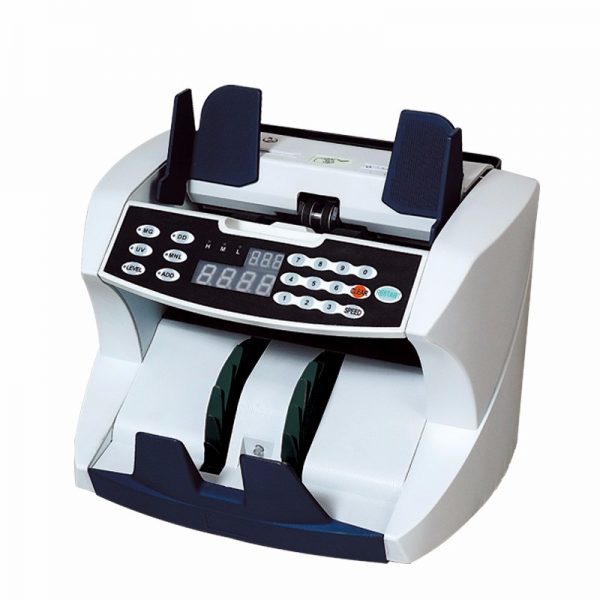
BAIJIA BJ-2100UV Currency Counting Machine
575.00 AED -
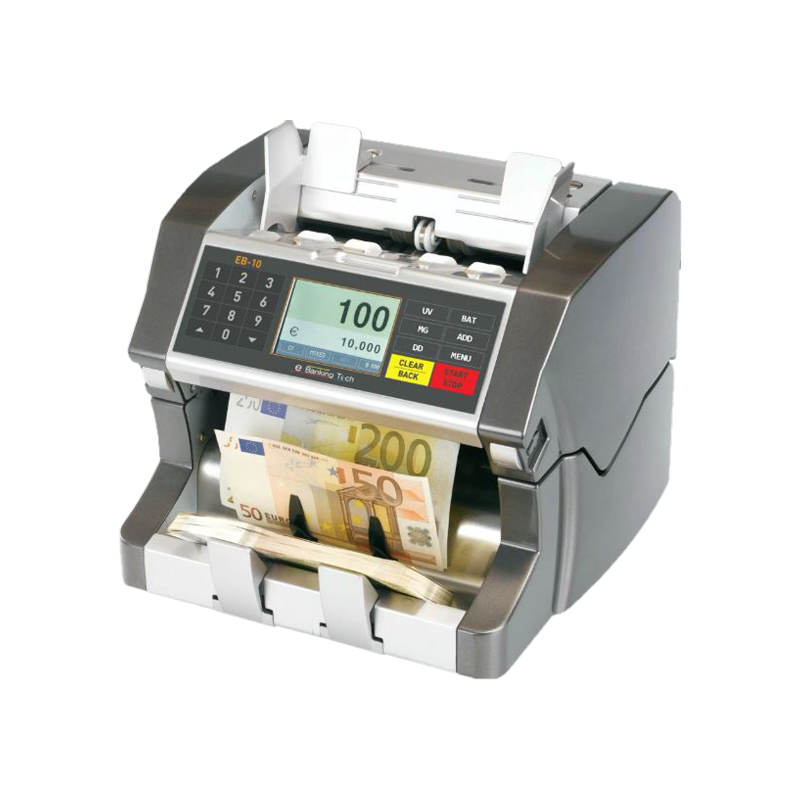
EBANKING EB-10 Heavy Duty Currency Counter
2,300.00 AED -
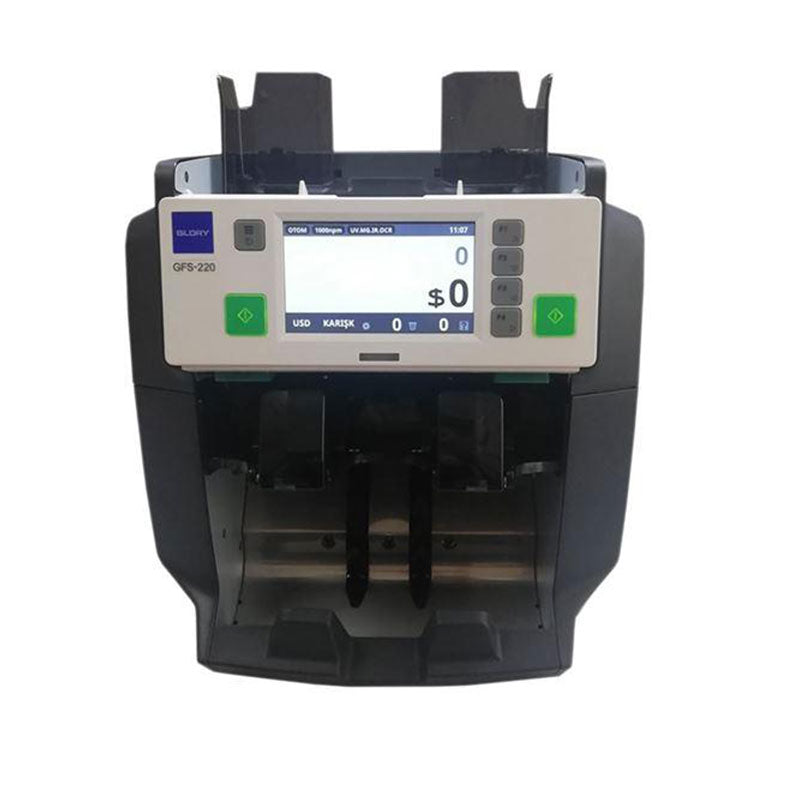
GLORY GFS220CS Banknote Counting Machine
9,200.00 AED
6. What’s the Real Price Range, and Why?
This is where a lot of buyers get confused, and fairly so. Currency counting machine prices in the UAE genuinely range from a few hundred dirhams for a basic single-currency counter to well over fifty thousand for a high-end multi-pocket sorter, and the gap isn’t random.
To put real numbers on it: the Hitachi IH-210 (3-pocket, 32 currencies) sits at AED 14,000. The Hitachi ST-350N (fitness sorting plus value counting) runs AED 26,450. These prices reflect sensor count, pocket count, currency library size, and brand engineering, not just marketing.
If you want a deeper breakdown of pricing by machine type and business use case, Ostmena’s Currency Counting Machine Price in UAE guide walks through the full range model by model.
7. What Happens After You Buy?
This question gets skipped constantly, and it shouldn’t. Currency counting machines are mechanical equipment that count thousands of notes a day. Rollers wear down. Sensors need calibration. New banknote series get released and machines need updated currency libraries to recognize them correctly.
Ask your supplier directly: Does the machine come with an annual maintenance period? Is local servicing available in the UAE, or does the unit need to be shipped elsewhere for repairs? The Hitachi IH-210, for example, includes 12 months of on-site periodic maintenance at no additional charge, which matters a lot more than it sounds once your machine has been running daily for six months.
A cheaper machine with no local support can end up costing more in downtime than a pricier one with proper after-sales backing.
Quick Comparison: Entry-Level vs Mid-Range vs High-End
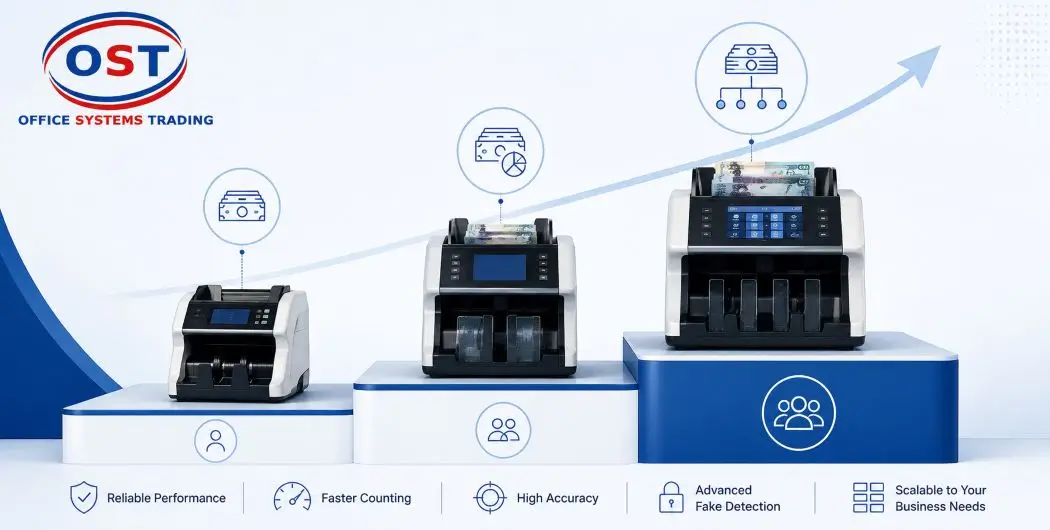
Entry-level — Machines like the Plus P-16 single-pocket counter suit small shops and teller counters that need reliable counting without heavy sorting demands.
Mid-range — The Plus P-30 (up to 15 currencies, 2-pocket) and Hitachi IH-210 (up to 32 currencies, 3-pocket, AED 14,000) fit exchange counters and hotels with moderate daily volume.
High-end — The Hitachi ST-350N (AED 26,450, fitness sorting) and Glory GFB-800 (up to 1,800 notes per minute) suit banks, large exchange houses, and CIT operations processing serious daily volume.
Get Matched With the Right Machine, Not Just a Machine
Guessing at specs is how businesses end up with equipment that’s either too small for their volume or loaded with features they’ll never touch. Tell Ostmena’s team your daily currency mix and transaction volume, and get a recommendation built around your actual workflow. Browse the full collection or check the Ostmena blog for more detailed buying guides.
Contact Ostmena’s team →Frequently Asked Questions
Prices vary widely by capability. Entry-level machines start in the low hundreds of dirhams, while mid-range multi-pocket sorters like the Hitachi IH-210 sit around AED 14,000, and high-end fitness sorters like the Hitachi ST-350N reach AED 26,450 and above.
It depends on your volume. If staff spend meaningful time manually separating notes before or after counting, the extra sorting pocket usually pays for itself in saved labor within a reasonable period.
This varies by usage volume and manufacturer, but many suppliers include a 12-month on-site maintenance period with purchase. After that, annual servicing is a reasonable standard to ask for.
Yes, as long as the model is genuinely multi-currency rather than single-currency with a “foreign note” gimmick. Models like the Hitachi IH-210 support up to 32 currencies loaded into the same unit.
Counting speed measures how fast the machine tallies and totals notes. Fitness sorting speed measures how fast it also checks each note’s physical condition, which is typically slower since the machine does more analysis per note.
