





Blogs
- What Is a Currency Counter & Sorter Machine?
- UV Detection Explained
- MG (Magnetic Ink) Detection Explained
- IR (Infrared) Detection Explained
- Why This Matters for UAE Businesses
- Ready to Stop Manual Counting? Talk to Ostmena Today
- Choosing the Right Machine: Real Models, Real UAE Pricing
- Get a Personalized Recommendation, Not Just a Product List
- Frequently Asked Questions
- Conclusion
Picture this: a busy teller in Deira takes a stack of AED 500 notes, counts them in ten seconds flat, and moves on to the next customer. No second glances. No manual checks. Then, three days later, the bank flags one of those notes as counterfeit.
That single note just became someone’s problem. Usually the business that accepted it.
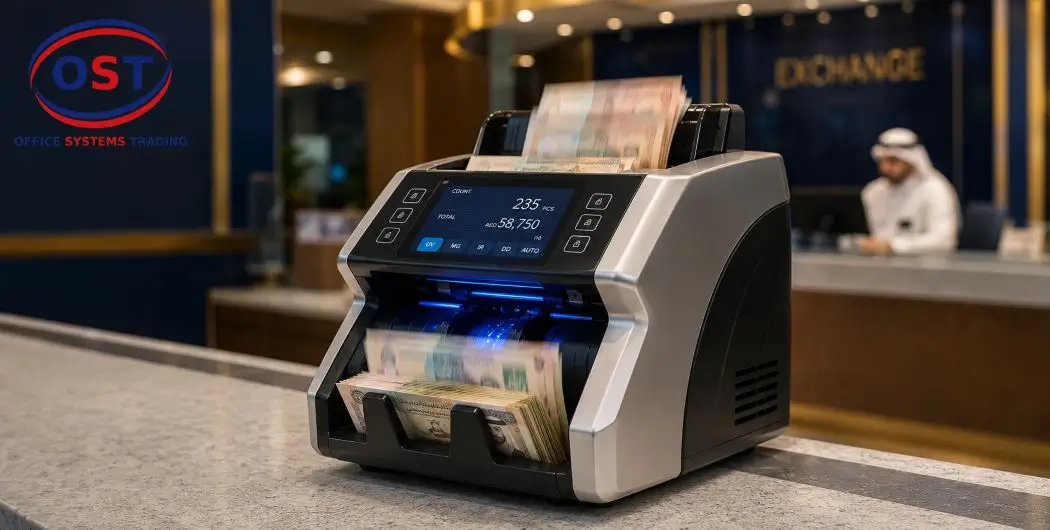
This is exactly why a currency counter & sorter machine with UV MG IR detection has become standard equipment for banks, exchange houses, and cash-heavy retailers across the UAE. It counts. It sorts. And it checks every note against three separate layers of counterfeit protection before the cash ever reaches a drawer.
In this guide, we’ll break down what UV, MG, and IR detection actually mean, how they work together, and how to pick the right machine for your business without drowning in spec sheets.
What Is a Currency Counter & Sorter Machine?
A currency counter tallies notes and gives you a total. A currency sorter goes a step further. It separates notes by denomination, checks their orientation, and groups them by condition.
Put both functions in one machine, and you get a banknote counter & sorter that does the counting and the quality control in a single pass. For a bank branch or exchange house processing thousands of notes a day, that combination saves real hours.
UAE businesses need both functions for a simple reason: cash volume here is high, currencies are mixed (AED sits next to USD, EUR, and half a dozen others in any exchange house drawer), and compliance expectations from the Central Bank keep rising. A machine that only counts leaves too much verification work for a human to catch reliably.
UV Detection Explained
UV detection uses ultraviolet light to reveal features that are invisible under normal lighting.
Genuine banknotes are printed with inks and threads that react to UV light in specific, predictable ways. The U.S. Currency Education Program notes that the security thread inside genuine Federal Reserve notes glows a distinct color under UV light, and that color varies by denomination. Central banks around the world use the same principle: a security thread or fiber that fluoresces only under UV.
A currency counter with UV detection shines an ultraviolet light across each note as it passes through and checks for that expected glow. If the glow is missing, wrong, or inconsistent, the machine flags or rejects the note.
UV detection is excellent at catching low-effort counterfeits, like a note produced on a standard printer using regular paper and ink, since regular paper does not fluoresce the same way. But it has a limit. Higher-quality counterfeits sometimes replicate a rough UV effect, which is exactly why UV detection rarely works alone in a serious cash-handling environment.
MG (Magnetic Ink) Detection Explained
MG detection checks for magnetic ink, a specialized ink used in specific, precise locations on genuine banknotes.
Research published by the National Academies Press notes that magnetic patterns are one of the core features that modern currency-reading machines rely on for authentication, alongside ultraviolet and infrared properties. Magnetic ink is genuinely difficult to replicate. It isn’t just “special ink.” It requires magnetic particles suspended correctly within the ink itself, printed at the right density in the right location.
A currency counter with MG detection uses a magnetic sensor to read that signature as each note passes through. Counterfeiters who nail the visual look of a note often fail here completely, because replicating the magnetic property takes far more specialized equipment than replicating color or texture.
This is why MG detection adds real value on top of UV. It’s a second, independent authentication layer. Fooling both at once is a much bigger ask than fooling one.
IR (Infrared) Detection Explained
IR detection reads how a note behaves under infrared light, which is a property invisible to the human eye entirely.
Some inks used in genuine currency printing are transparent or absorbent specifically under infrared light, creating hidden patterns that only IR sensors can pick up. The National Academies Press research describes infrared ink properties as one of the primary features used by modern machine readers, precisely because these properties are difficult for counterfeiters to reverse-engineer without specialized knowledge of ink chemistry.
A currency counter with IR detection scans each note with infrared light and compares the resulting pattern against what a genuine note should produce. This catches a category of counterfeit that both UV and MG might miss, since it’s checking an entirely different physical property of the ink.
| Detection Type | What It Detects | Best Used For |
|---|---|---|
| UV | Fluorescent threads and inks visible only under ultraviolet light. | Catching basic counterfeits and printer-produced fake notes. |
| MG | Magnetic ink patterns in specific printed zones. | Catching visually convincing counterfeit banknotes. |
| IR | Infrared-reactive ink and hidden security patterns invisible to the naked eye. | Catching sophisticated counterfeits that mimic UV and MG security features. |
Put all three together, and you get a machine that checks a note against three separate, physically independent properties. A counterfeiter has to fool all three at once. That’s a much taller order than fooling one.
Why This Matters for UAE Businesses
The UAE takes currency integrity seriously, and the law reflects that. Under the UAE Penal Code, knowingly circulating counterfeit currency can carry a prison sentence and a fine starting at AED 200,000, with life imprisonment possible if the offense affects national currency stability. Even accepting a counterfeit note by mistake and later trying to pass it on to someone else can result in penalties once the business knew it was fake.
For licensed financial institutions specifically, the Central Bank of the UAE’s rulebook holds them accountable for preventing the circulation of counterfeit or forged notes, with fines starting at AED 10,000 per counterfeit note on top of its face value.
That’s the blunt version: a basic UV/MG/IR counter costs a fraction of what a single compliance mistake can cost. It’s cheap insurance, not an optional upgrade.
Beyond compliance, there’s a practical business case too. UAE exchange houses handle a genuinely wide mix of currencies. Mixed-denomination sorting and multi-currency recognition aren’t nice-to-haves here, they’re daily necessities. A machine built for one currency in a one-currency country doesn’t translate well to a Dubai exchange counter handling AED, USD, EUR, and GBP in the same hour.
Ready to Stop Manual Counting? Talk to Ostmena Today
If your team is still hand-counting cash or relying on a basic counter with no real counterfeit protection, every busy day is a small risk multiplied by however many notes cross your counter. Browse Ostmena’s full range of currency counting and sorting machines → and find a model that matches your actual daily volume, not just your budget on paper.
Choosing the Right Machine: Real Models, Real UAE Pricing
Here’s where the spec sheet meets the real world. Ostmena carries models across the full range, from compact retail counters to bank-grade sorters, so you can match the machine to your actual workload instead of overpaying for capability you’ll never use.
Entry-level counter with UV/MG detection: The MIRAGE SY-10 UV Automatic Currency Counting and Detecting Machine is priced at AED 402.50 and covers UV and MG detection in a compact footprint. It suits small retail counters that need basic counterfeit protection without a large machine footprint.
Multi-currency counter for mixed cash drawers: The MIRAGE SY-100 Banknote Counting Machine with 15 Currencies is priced at AED 2,731.25, with a hopper capacity of roughly 500 notes and counting speeds suited to a busy till handling more than one currency.
Full UV, MG, and IR discriminator (the star of this guide):
The HITACHI IH-100 Currency Counter/Discriminator with Single Pocket runs all three detection modes discussed above (UV, MG, and IR) and is priced at AED 4,082.50. It’s built as an intelligent single-pocket counter and discriminator, using full IR CIS sensors to recognize note value across supported currencies.
Bank-grade fitness sorter for high volume: For businesses processing large batches daily, the HITACHI ST-350N Smart Multi Currency Sorter & Counter fitness-sorts notes for holes, tears, stains, and folds at up to 700 notes per minute, with high-resolution dual CIS scanning for authentication.
Top-tier enterprise sorter: On the high end, the HITACHI MS-4200 is priced at AED 57,500.00, built as a fast, multi-functional sorter for institutions with heavy daily cash volume.
Not sure which tier fits your business? Ostmena’s own Currency Counting Machine Price in UAE buyer’s guide breaks down pricing by machine type in more detail, and the Best Currency Counter for Retail Shops guide is a solid read if your business skews more retail than banking.
Prices reflect current listings at the time of writing and may change. Always confirm the latest price on the product page before ordering.
Get a Personalized Recommendation, Not Just a Product List
Every business counts cash differently. A boutique closing one till a night has nothing in common with an exchange house processing five currencies before lunch. Reach out to Ostmena’s team → for a recommendation based on your actual daily volume, currency mix, and note condition, so you buy the machine that fits, not the one that just looks impressive on a spec sheet.
Frequently Asked Questions
UV, MG, and IR are three separate counterfeit detection methods. UV checks for fluorescent ink and threads under ultraviolet light. MG checks for magnetic ink in specific printed zones. IR checks for infrared-reactive ink patterns invisible to the naked eye. Machines combining all three run each note through three independent checks instead of one.
A UV/MG/IR machine significantly reduces counterfeit risk, but no machine offers an absolute guarantee against every possible counterfeit. Regular maintenance, sensor cleaning, and keeping the machine’s software or currency library updated all matter for accuracy over time.
Yes, it’s worth treating as standard rather than optional. Exchange houses handle high foot traffic and multiple currencies daily,
which raises exposure to counterfeit risk compared with a single-currency retail till.
This varies by model and usage volume, so it’s best to follow the manufacturer’s recommended service schedule.
High-volume machines used daily in banks or exchange houses typically need more frequent sensor cleaning and calibration checks than a low-volume retail counter.
Ostmena supplies a full range of currency counting and sorting machines from established brands including
Hitachi and Mirage, with UAE-based support. You can browse the current lineup here.
Conclusion
UV, MG, and IR detection aren’t marketing buzzwords stacked onto a spec sheet. Each one checks a genuinely different physical property of a banknote, and together, they make a counterfeit note much harder to slip past your counter unnoticed.
For UAE banks, exchange houses, and cash-heavy retailers, a currency counter & sorter machine with UV MG IR detection isn’t just about speed. It’s about closing a specific compliance and financial risk that a basic counter simply can’t touch. Whether you need an entry-level counter or a bank-grade sorter, matching the machine to your actual cash volume is the real decision that matters.
Ready to find the right fit? Explore Ostmena’s currency counting and sorting machines and put an end to manual recounts for good.
